
Contents of the Data Catalog
This data catalog is designed to cover observed atmospheric greenhouse gas (GHG) concentrations and carbon cycle processes in the marine and terrestrial ecosystems, along with their associated emissions and removals. These components are linked through the carbon balance, enabling the estimation of fluxes from atmospheric concentrations using inverse analysis1.
Observed atmospheric concentrations include in situ observations from land, ships, and aircraft, as well as remote sensing from satellites and other platforms. These observations are harmonized through standardization and calibration, providing a coherent observational basis that constrains inverse analysis. Emissions and removals are compiled on a bottom-up basis from statistical data in accordance with the IPCC reporting guidelines. Inventories are compared, to assess consistency, against top-down estimates derived from inverse analysis, as well as estimates from process-based models driven by carbon cycle observations.
These data on greenhouse gas concentrations, fluxes, and carbon budgets are expected to be widely used not only for measurement, reporting, and verification (MRV) activities at the national, regional, and corporate levels, but also for building knowledge of the climate system among educational institutions and individuals.
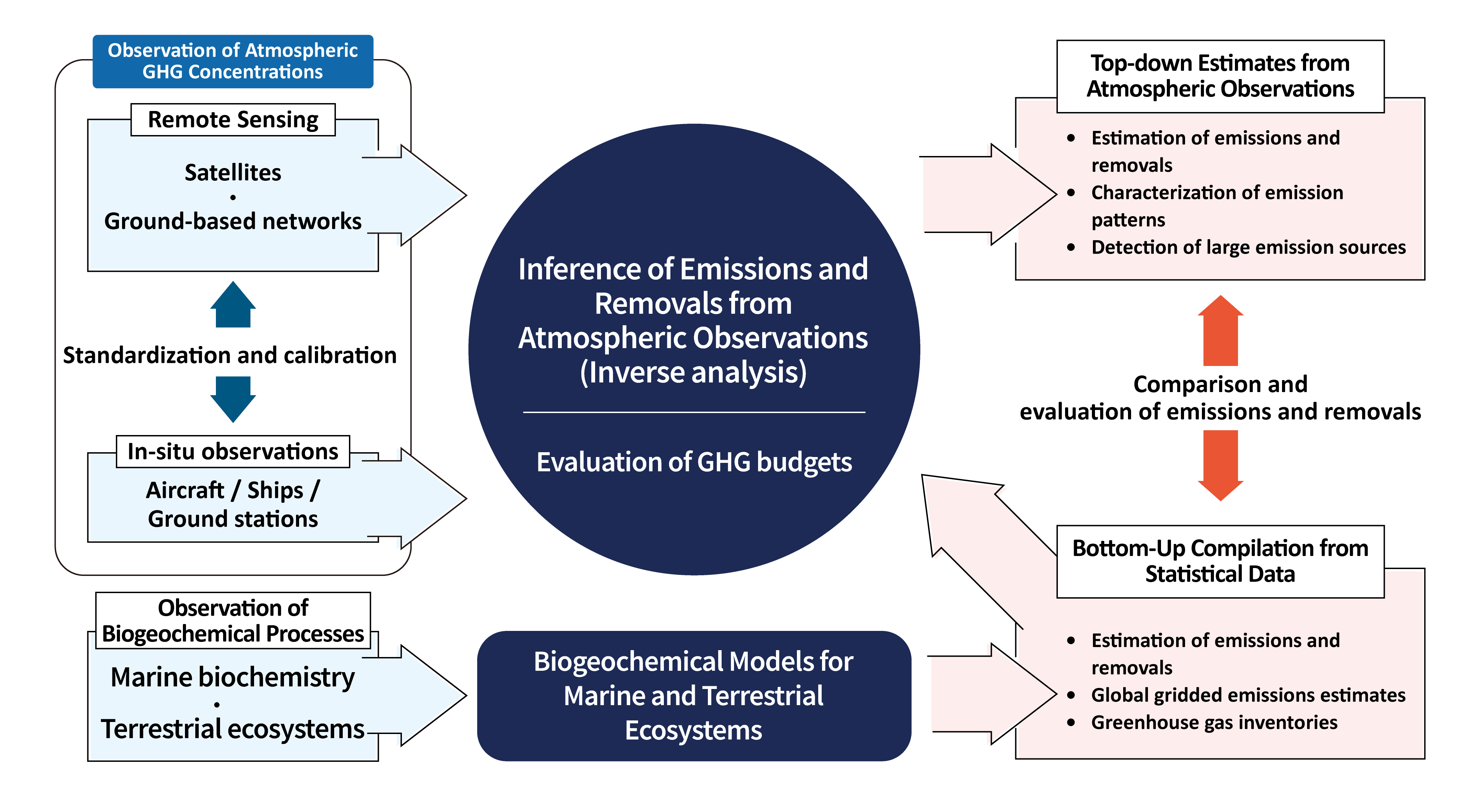
1Inverse analysis is an approach to estimate the amount and distribution of surface emissions and removals, based on observed atmospheric greenhouse gas concentrations. These estimates are derived by adjusting the fluxes so that the simulated and observed concentrations agree as closely as possible.