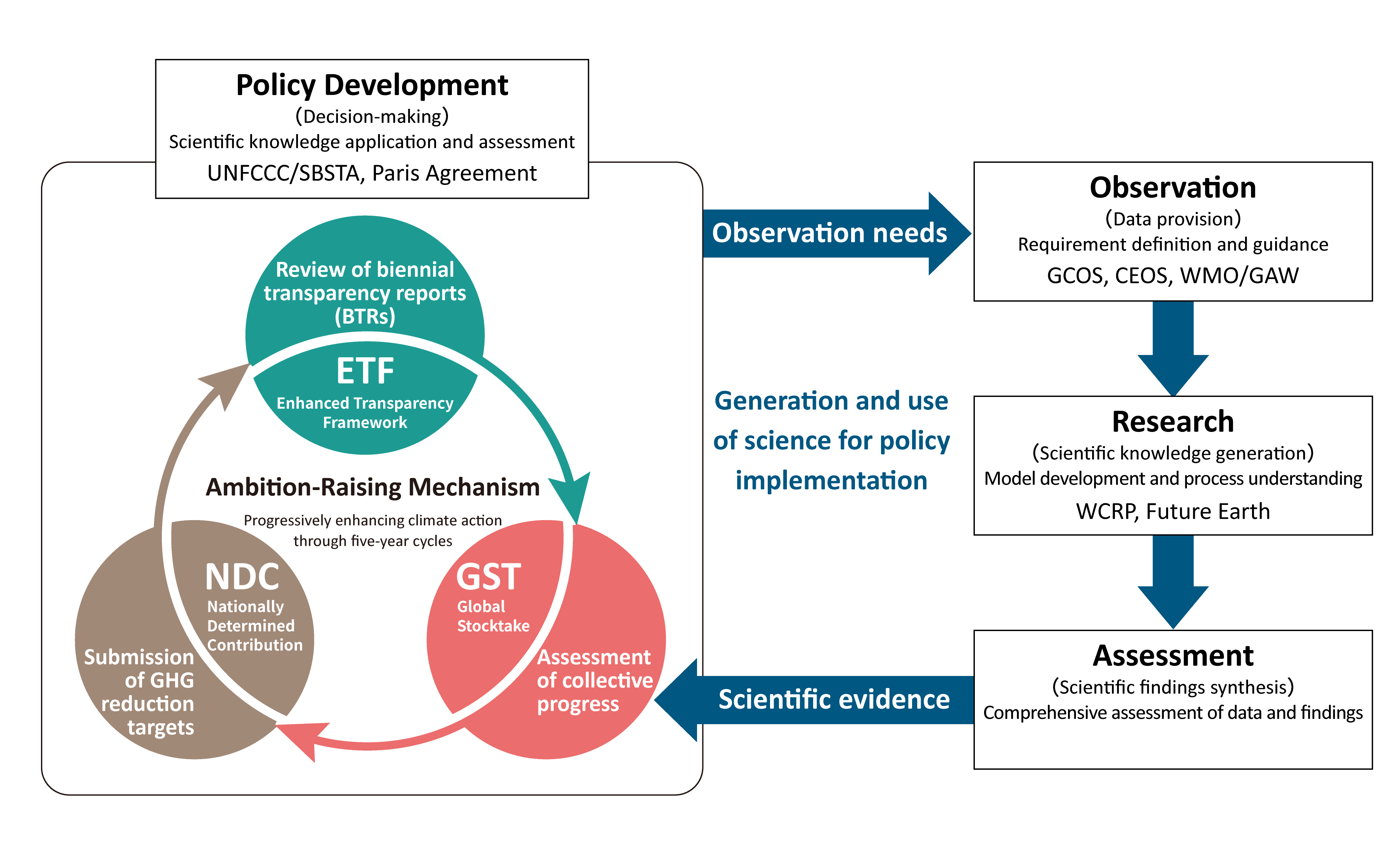
Role of Science in Climate Policy
The United Nations Framework Convention on Climate Change (UNFCCC), adopted in 1992, establishes as its ultimate objective the stabilization of atmospheric greenhouse gas concentrations at a level that would prevent dangerous anthropogenic interference with the climate system (Article 2), and calls on the Parties to support and further develop research and systematic observation (Article 5). In response to the observation needs of the UNFCCC, the Global Climate Observing System (GCOS, established in 1992) defines the observation requirements for the climate system, including greenhouse gases, and provides guidance to observation implementation bodies such as the Committee on Earth Observation Satellites (CEOS) and the World Meteorological Organization (WMO) to facilitate their implementation. The observation systems and long-term data developed under these frameworks are leveraged in research initiatives, such as the World Climate Research Programme (WCRP) and Future Earth to advance understanding of climate processes and model development, also serving as an essential foundation for monitoring and understanding the climate system, including the carbon cycle and associated climate feedbacks. Evidence from research and systematic observation is comprehensively assessed by the Intergovernmental Panel on Climate Change (IPCC) and synthesized into policy-relevant knowledge through the UNFCCC’s Subsidiary Body for Scientific and Technological Advice (SBSTA). This scientific process provides an evidence base for international negotiations at the Conference of the Parties (COP) and for policies and actions at the national level.
The Paris Agreement (adopted in 2015) establishes a framework under which each Party submits its nationally determined contributions (NDCs (Article 4), setting out specific greenhouse gas reduction goals, and reports on its NDC implementation status through a biennial transparency report (BTR), subject to technical expert review under the enhanced transparency framework (ETF) (Article 13). Moreover, the global stocktake (GST) (Article 14) assesses the collective progress toward the Paris Agreement’s long-term goals every five years. The GST’s outcomes are intended to inform the subsequent updating of NDCs, forming an iterative 'ratchet mechanism' to progressively enhance ambition. Observational data, such as greenhouse gas concentrations, and model products, including inverse-analysis-based emission estimates, and scientific assessments by the IPCC support the tracking and visualization of each Party’s NDC implementation status under the ETF. Furthermore, the GST assesses the gap between collective progress and the Paris Agreement’s goals based on scientific evidence. These processes serve as a robust basis for updating the target levels of NDCs (raising ambition) and represent a concrete example of science informing policy.
Relevant institutions in Japan contribute to providing observational data and disseminating research findings related to greenhouse gases (GHGs), through collaboration with domestic and international partners across the chain from research and systematic observation to assessment. In addition, Japanese scientific knowledge and data continue to inform and support the ongoing ambition-raising process under the Paris Agreement, playing an important role in advancing international climate action and policymaking.