

The Earth System Division contributes to a sustainable global environment by sharing its research findings and the latest scientific knowledge on climate change with the world through international frameworks, including the United Nations Framework Convention on Climate Change (UNFCCC).
About the UNFCCC COP
The Conference of the Parties (COP) to the United Nations Framework Convention on Climate Change (UNFCCC) is an international meeting where countries and regional organizations come together to discuss and negotiate measures to address climate change, including mitigation, adaptation, and climate finance. Since the first meeting (COP1) in 1995, the COP has been held annually and attracts a wide range of participants, including government representatives, research institutions, international organizations, businesses, and civil society groups from around the world. It serves as an important forum for shaping the global direction of climate action and fostering international cooperation on climate change.
The Role of the Earth System Division at the COP
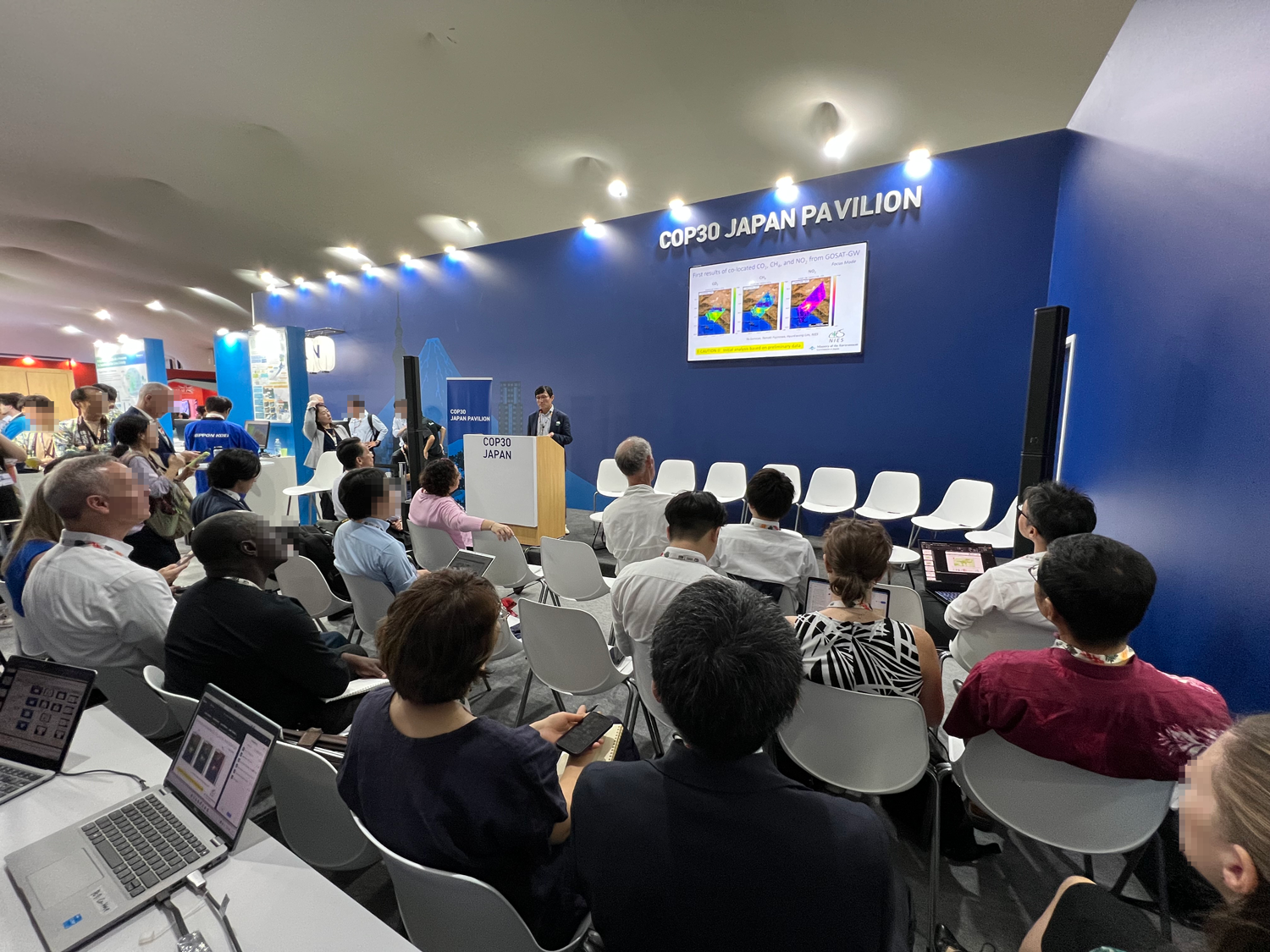
The Earth System Division is committed to generating scientific knowledge that contributes to global environmental conservation through observations, analyses, and modeling studies that are essential for understanding climate change and projecting future environmental conditions. Another important part of our mission is to share research findings and observational data with the international community and to help bridge the gap between science and policy.
As one of the key forums for such engagement, the National Institute for Environmental Studies (NIES) has participated continuously in the COP, contributing as a member of the Japanese government delegation, providing expertise on greenhouse gas inventories, and disseminating research outcomes through side events and exhibitions.
In recent years, the Division has actively communicated the achievements of its Earth observation initiatives, including the Greenhouse Gases Observing Satellite (GOSAT) series. In particular, GOSAT-GW is expected to play an important role in monitoring greenhouse gases and the global water cycle. By sharing observational data and research findings from GOSAT-GW with the international community, the Earth System Division contributes to climate action and global environmental conservation based on sound scientific evidence.
COP Special Websites
Please visit the COP Japan Pavilion websites linked below to explore events organized by the Ministry of the Environment, Japan, and the Earth System Division of the National Institute for Environmental Studies (NIES). Further information on NIES's participation in previous COP sessions is available from the NIES website.