A3 Workshop Report: Busan
The current A3 program began in August 2022. At the outset, however, various obstacles—such as travel restrictions due to the COVID-19 pandemic—meant that activities during 2022 were centered mainly on online meetings among the core members. Around December 2022, anticipating that restrictions related to infectious-disease countermeasures would be eased by early spring of the new year, we began preparations to hold an in-person workshop in Busan, Republic of Korea, as a kickoff meeting.
This A3 program is essentially a successor to the A3 project implemented from 2007 to 2012 (commonly known as “A3-CarboEastAsia”). Under A3-CarboEastAsia, Japan, China, and Korea—based on an equal partnership—developed national networks within each country and created a framework to link those three networks. Although AsiaFlux had been active mainly among Japan’s flux researchers, A3-CarboEastAsia served as the catalyst for establishing JapanFlux as Japan’s national network. From its establishment to the present day, the secretariats for both AsiaFlux and JapanFlux have been located at the National Institute for Environmental Studies (NIES), which is also the hub institution for the current A3 program.
Through research exchanges under A3-CarboEastAsia, many early-career researchers in Japan, China, and Korea became active and grew professionally. A large portion of the core members in the current A3 program are researchers who advanced their careers through A3-CarboEastAsia. Over the ten years between the end of A3-CarboEastAsia and the start of the present A3 program, the landscape surrounding greenhouse-gas flux research has changed substantially. In observation technology, the development and widespread adoption of laser spectroscopy gas analyzers has made it increasingly common to study not only CO₂ but also other warming-related gases such as CH₄ and N₂O. In numerical modeling, data-driven models incorporating machine-learning approaches have advanced rapidly alongside process-based models. For regional assessments, available information has grown dramatically, including satellites capable of observing greenhouse gases, various optical satellites with high spatial resolution, and geostationary satellites with high temporal resolution; validation observations that connect satellite and ground-based measurements are also becoming increasingly important.
Global-scale environmental issues such as climate change require cooperative efforts over decades and are not problems that can be resolved within the active careers of today’s research leaders. As the sophistication of Earth observation continues to increase, the importance of training the next generation of researchers—who can combine diverse information to drive new scientific developments—is becoming ever greater. In Japan, particularly in research fields that support Earth observation, fewer students are aspiring to become researchers. Under these circumstances, the shared goal of the core members in Japan, China, and Korea is to use this newly launched A3 program to provide opportunities for early-career researchers, raise their motivation, strengthen future trilateral collaboration, and further revitalize research fields that can lead the broader Asian region.
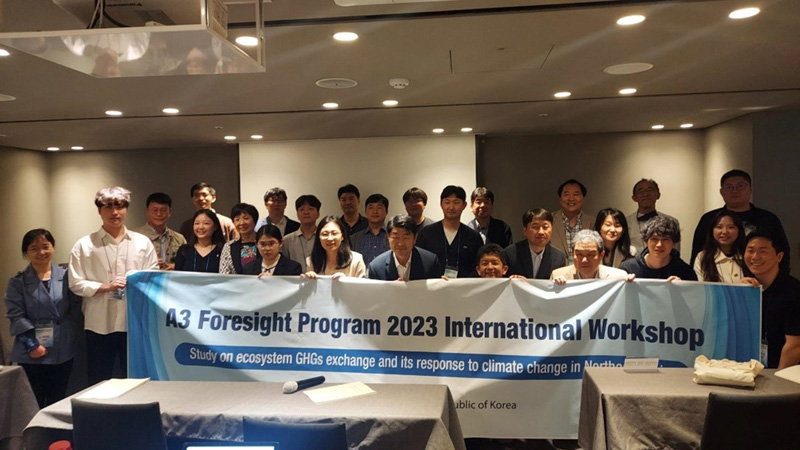
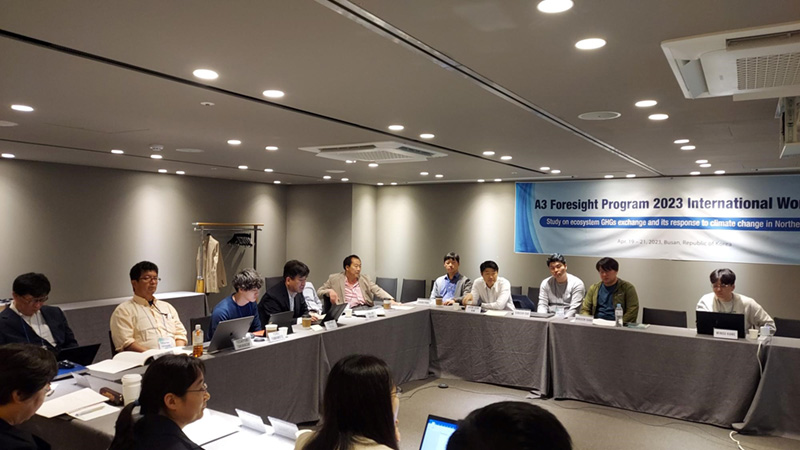
Now, the A3 International Workshop in Busan—the kickoff meeting in Busan—was held in April in Busan, Republic of Korea, over a schedule of two nights and three days. Because it was necessary to advance discussions such as developing policies for future research exchanges, roughly ten participants from each of the three countries, mainly core members, attended. They introduced research topics in their respective countries and brainstormed ideas on how to proceed with future exchanges. Discussions included setting several key sub-themes and advancing activities primarily through corresponding core members across the three countries, as well as soliciting research themes through an open call. Although the meeting period was very short, members from Japan, China, and Korea who previously participated in A3-CarboEastAsia as early-career researchers this time engaged in enthusiastic discussions as leaders. In the evenings, they deepened friendships while sharing memories from the past and challenges in the present over local cuisine. Although this A3 program’s launch was strongly affected by the COVID-19 pandemic, we would like to make the utmost effort to seize this opportunity and help invigorate this research field in Japan.